
Every now and then, we firearms folk walk into a gun shop and find something that just grabs us by the eyeballs. That was my experience in early March when I visited Ernie Traugh’s Cedar Valley Outfitters in Cedar Rapids, Iowa. The gun in question was a Smith & Wesson Model 17, the classic K-22, with the uncommon 8 3/8” barrel.
I got my first K-22 before I got my driver’s license, the early model that S&W called the Outdoorsman when they introduced it in the early 1930s. (Didn’t get it then, though; I just LOOK that old. Would’ve been early 1960s when it came into my eager, then-young hands.)
I already had a few of the six-inch barrel versions of this six-shot .22 Long Rifle revolver, and one of the four-inch barrel versions, the Model 18. I’ve owned the “long Tom” 8 3/8” barrel S&Ws in .357 Magnum and .44 Magnum, but never one chambered for .22 rimfire, the most popular cartridge in the country.
Ernie gave me a good deal, as he typically does; I wrote him a check, and he set the K-22 aside until a dealer in my state could get a copy of my Federal Firearms License to him. I spent most of the month on the road, and didn’t get to pick it up at my local gun shop and shoot it until now.
The .22 Long Rifle round has been one of the most useful for rural Americans since its introduction in the year 1887. Ridding the farm of predators, vermin, and uninvited produce consumers, and feeding the family with rabbit, squirrel, head-shot grouse and more for about as long, the .22 LR has earned its place as the most popular American cartridge. The overwhelming majority of that ammo has been fired through rifles, but over the decades, target-grade .22 handguns have proven that within their range, they can do the same job. And for every .22 round that ever bagged meat, there were probably hundreds if not thousands just fired at inanimate targets for fun.
I didn’t buy the long-barreled K-22 for blasting bunnies to create hasenpfeffer, though. Truth to tell, I bought it for…fun.
Beautifully crafted, it is a song in steel, sung to celebrate American workmanship. This one, “pre-owned,” was fitted by its previous custodian with a pair of Hogue grips. It shot a bit left for me at 25 yards. Well, that’s why they came with adjustable sights. The gentle kiss of the screwdriver will fix that.
With that extra-long barrel, you’d think it would be more accurate than a standard-length K-22. It wasn’t. Balanced nice in the hand, though.
I bought it because it was…cool.
And, in the end, that’s reason enough.
Bet some of you out there have guns you didn’t really need, but bought for similar reasons. Share with the rest of us. The folks who come here understand.
The S&W K-22 under discussion, with eight and three-eighths inch barrel.
Mas writes the check while Ernie, holding the gun he’s selling, does the paperwork. Mas got the better part of the deal, he thinks.
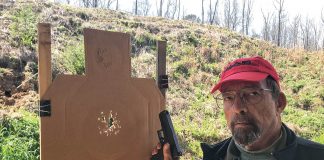
The first six shots from the K-22 at 25 yards. Yes, a little left, but that’s why they have adjustable sights…
Good lord, the thing with carrying guns in Starbucks has become a theme in Doonesbury this week. A certain kind of lightweight yuppie seems to morbidly fear those who are comfortable with a power they can’t imagine themselves wielding.
Some fellas just need to unbunch their panties and take a look at real world responsibilities. In a nation of some 320 million people, well under a million police officers simply aren’t enough to proactively protect everyone. Do the math. Self-defense is a natural personal responsibility, right up there with first responder emergency medical abilities. Those whose stomachs are too weak to accept their own capability in this regard seek to denigrate those who do live up to their responsibilities. Sad, really.
Such people have for decades opposed the carrying of handguns for personal protection by ordinary citizens, wailing that “blood will run in the streets” and there will be “shootouts over parking spaces.” Of course, that hasn’t happened…but reality doesn’t seem to get in the way of their stridently-voiced panic.
THIS LINK confirms that despite the fact that guns have proliferated greatly in the last few years – and so has the ability to legally carry them loaded and concealed in public – the rate of violent crime has gone DOWN during the same timeframe.
Begorrah…bein’ a quarter Irish as I am, I could think of no better way to spend a St. Patrick’s Day than with a lovely colleen…so, on March 17, Gail Pepin and I sat down with Colleen Lawson of Chicago, one of the named plaintiffs in McDonald, et. al. v. Chicago. This, you’ll recall, is the landmark case now being deliberated by the Supreme Court of the United States, to determine whether the same body’s decision in Heller v. Washington, DC two years ago is binding upon jurisdictions other than the District of Columbia.
Mrs. Lawson’s perspective gives her understanding of the issues from many angles. A native Chicagoan, she has seen crime go up pervasively in the windy city. Living in a nice neighborhood, she knows that crime does not confine itself to the blighted inner city. As a person of mixed race, she has learned that racial hatred still exists in America. As a woman and a mother of daughters, she has learned that misogyny exists, too, and that criminals who hold women in contempt can be particularly violent toward them. Finally, she has learned that in a world where predators abound, the helpless are merely prey.
She can tell you of the day she looked through the window of her back porch door at the hostile faces of men who were breaking into her home, the battered door one more blow away from coming down, her face literally inches from theirs with only the fragile, damaged door in between. That particular encounter ended well, but left a strong sense of vulnerability. Since then, she has been an advocate for a responsibly armed citizenry, and for the civil rights of gun owners.
The mere possession of handguns has been banned in the City of Chicago since 1982. Colleen acquired a 20-gauge shotgun, but notes that it is much bulkier and more unwieldy than a handgun, particularly for a woman with less upper body strength than a man. Her position is that the Chicago handgun ban has disparate impact upon women. Who, with any degree of credibility, can disagree?
Colleen’s articulate plea for sanity and basic civil rights can soon be heard on the Pro-Arms Podcast, http://proarmspodcast.com. Our interview with Otis McDonald, the lead named plaintiff in the case (see below) will soon be there too, both downloadable to computer or iPod at no charge. Ms. Lawson’s interview with Pro-Arms Podcast producer Gail Pepin will be part of the all-women’s series within a series, the Broad Cast. When next in Chicago, we hope to interview the two other named plaintiffs, Adam Orlov and Colleen’s husband David Lawson.
I spent part of yesterday with Otis McDonald, the lead named plaintiff in McDonald v. Chicago, now under deliberation by the United States Supreme Court. When the Second Amendment Foundation mounted this challenge to the Chicago handgun ban, they could not have made a better choice. Mr. McDonald is your quintessential hard-working, self-made American.
Beginning life as the son of a sharecropper in Mississippi, he served in the United States Army, spent thirty years working for a university, and is now trying to finish his life in peaceful retirement with his spouse. However, the Chicago neighborhood where he has owned a home since the 1970s has been increasingly blighted by dope dealers, gang-bangers, and the sort of punks who harass and harm the elderly. He has been threatened on the street, and his home has been broken into numerous times.
Those who say, “You don’t need handguns because you can always buy a shotgun for home defense” should sit down with an open mind and listen to someone such as Mr. McDonald. “I’m 76 years old,” he points out. “Yes, I own long guns…but how long do you think it will take me to get up, get out of bed, and get my hands on a shotgun if someone is breaking in through the bedroom window?”
Justice Scalia wrote something similar in the majority opinion in Heller v. District of Columbia, which confirmed that the Second Amendment was an individual right, and set the stage for McDonald, which will determine whether the states are bound by the Heller decision.
Otis McDonald’s compelling words will soon be posted on the Pro-Arms Podcast, http://proarmspodcast.com. One of the last questions I asked him was what sort of handgun he planned to acquire if, as almost all SCOTUS watchers predict, the case that bears his name results in an opinion that shoots down the nearly 30-year-old Chicago handgun ban. His answer? A 1911 model .45 caliber semiautomatic pistol…a gun he became familiar with as a soldier defending his country.
Those who would deprive American citizens of the right to protect themselves and their loved ones against criminals who are capable of killing them, are not handling their portending defeat well. According to “the usual pundits,” the indications from the recent US Supreme Court arguments in McDonald v. Chicago arethat SCOTUS is likely to soon confirm that, for all the states in the union and not just the District of Columbia, the right to keep and bear arms extends to all Americans.
In Chicago, where the mayoralty seems to have become a royal dynasty, the ferociously anti-gun mayor seems to be virtually foaming at the mouth. Mayor Daley says that “we” – him as well as the rest of us, apparently – killed John Kennedy, Robert Kennedy, and Martin Luther King. Think I’m kidding? Catch the confirmation HERE.
Jeez, King Richard…if you’re copping to all of those with the inclusive “we,” you’re going to completely rewrite the whole crackpot conspiracy book. By the way, Mayor Daley, how come you didn’t mention that after you banned handgun ownership to honest, decent people in the city of Chicago, your city experienced a 41% rise in murders while the rest of the nation was less than half that, at an 18% increase?
The Second Amendment Foundation funded and “backboned” the McDonald case, but it is significant to look beyond the lobbyists and into the faces of the plaintiffs in the case themselves. Chicago magazine did so, HERE.
When you go to the latter link, notice that these are the faces of ordinary, hard-working American citizens. This isn’t about lobbyists in thousand dollar suits. Look at the face of the plaintiff after whom the case is named: Otis McDonald, a septuagenarian black man who lives in a tough part of a tough city, and wants to be able to keep his family safe, as well as himself. The hypocritical mayor is surrounded by a bodyguard contingent of well-armed Chicago police officers. In the best tradition of self-reliant Americans, Otis McDonald isn’t asking for elite warriors from a 13,000 person police force in a city of millions to be assigned exclusively to protect him and his, as Daley has…he is only asking for the basic human right, the basic American right, to protect himself and his loved ones.
I’ve had the privilege of speaking with Otis McDonald. Before too long, I will interview him on this matter. You will read what he has to say, here.
Look upon the face of the lead plaintiff in McDonald v. Chicago.
Look upon the face of freedom…the face of core human rights in our nation.
Adam Orlov, David and Colleen Lawson, and Otis McDonald, the lead named plaintiff in McDonald v. Chicago, now being deliberated by the Supreme Court Of The United States.
Have questions regarding this Blog? Please email us. Comments may appear online in "Feedback" or in the "Letters" section of Backwoods Home Magazine. We read every email you send us, but due to the sheer volume of mail we receive, we can't respond to each one.