
Yesterday morning, I listened to the on-line stockholders’ report from Sturm, Ruger Inc., delivered by Mike Fifer, the current CEO.
I had the impression of an honest man giving honest answers to honest questions.
I knew and admired the late Bill Ruger, Sr., the company founder. He was always proud that his corporation had no debt. That’s still true today. Too bad we never elected a man like that to run the whole damn country. Congrats to Fifer and his crew for keeping that paradigm intact.
Item: there are some 300 different SKUs (Stock-Keeping Units, or specifically different products) now being shipped out of the Ruger plants in Newport, NH and Prescott, AZ.
Item: the newly introduced products are the ones that are selling best. Welcome to typical American consumer values. “We want new! We want it now!” (That’s me talking, folks, not Fifer…but apparently Fifer is seeing the same thing.) The small frame LCR revolver introduced last January, and the LCP .380 pistol introduced the year before, figure hugely in those massive sales, which seem to be up somewhere around two-thirds higher than the previous year.
Item: innovation is alive and well in American gunmaking. Said Fifer, “We took orders for three times what we thought the best case scenario would be, during the first 48 hours of the (2008) SHOT Show. (Shooting, Hunting, and Outdoor Trade, the primary industry show in the firearms world). We’ve been adding engineers left and right, made offers to two this week, and are still looking for more.” Concluded Fifer, “I don’t think we have enough new products.” Fifer later added that while there are teams working on new platform products, established products are still getting “line extension” – modifications that better suit them for specific purposes for which a market has been identified. The bottom line is that new projects are getting the most attention.
This blogger’s take…
Fifer has done his homework. He has under his command some of the most brilliant engineers currently working in the firearms industry, and some of the most savvy marketing folks who best understand the real motivations of the people who buy guns.
Personally, I was impressed as hell with their SR556 interpretation of the AR15 rifle. Fifer was candid enough to say in his talk to the stockholders, “There were some cost overruns on the SR556, but it will be a good long term product for us.” (Damn, in this blog several months ago, I TOLD ya the SR556 would be a good buy for the consumer. When the manufacturer admits it costs too much for him to make, that’s nature’s way of telling the consumer he just got a helluva deal.)
Fifer and his people get out and go into gun shops. They talk to consumers. (Interact with those who buy and sell what you make? THERE’S an idea whose time has come!) They’ve noted that empty shelves are filling back up again, more with guns than with ammunition.
Bottom line? Ruger is a profitable company to invest in because it listens to its end-user marketplace. That’s what makes companies successful in this country. That’s what Bill Ruger, Sr. did to make his company successful.
I still remember standing beside Bill Senior’s grave on the day of his funeral…but right now, I have to think he would be proud of where his company has gone since he left us.
Ruger’s LCR, introduced this year, is selling extremely well.
Just got back from six days in Tallahassee, five of them at the Pat Thomas law enforcement training center both studying and teaching at the High Liability Instructors Conference, and one day prior shooting the pistol match that was ancillary to the event. Practice was a constant thread that ran through the entire experience.
The two events that kill more cops than anything else are shootouts and car crashes. There was heavy emphasis on preparing for both. When your vehicle is slewing out of control is a lousy time to START getting experience in steering out of a skid. That’s why the $45,000 Skid Car device we mentioned in the last post is absolutely worth its price for training purposes. Training costs are cheaper than death benefits and lifelong Workman’s Comp, and those two things are exactly the stakes on the table. As cops have long said, it’s better to sweat in the training environment than to bleed in the street.
The pistol match kinda brought that home for me, and for the significant other. She’s the current state and regional women’s champion in International Defensive Pistol Association shooting, and being five feet tall, was chosen to teach the bloc for instructors on how to adapt small-handed female officers to full-size issue service pistols. Primarily an auto pistol shooter, she grudgingly practiced with her “old fashioned” Smith & Wesson Model 67 revolver. The practice paid off at the match: she won High Woman in the service revolver category.
I had practiced with her, something I don’t usually have time to do before a match anymore. The practice paid off for me, too. Another truism in law enforcement is that “in a fight, you won’t rise to your greatest possible ability, but will probably default to your training.” This course involved the police B27 silhouette target fired in competition mode, which means that the target is a 2” X 3” oval tie-breaker X-ring, fired at under time constraints from as far as 25 yards. The practice scores were consistently 100% in “qualification mode,” but in the much tougher “competition mode” scoring they ranged from 97.5% to 99.2%. Did I skyrocket with a flash of brilliance and shoot 100% on match day? Hell, no…but I did default to the 97.5% bottom line of performance “on demand,” and that was enough to win the revolver match (S&W Model 64 .38 Special, 4” barrel) and the pistol match (Beretta Model 92 9mm), and take the overall win. For me, practice beforehand hadn’t delivered stellar performance, but it HAD helped to guarantee a safety net where “fallback” wouldn’t fall TOO low.
The lesson is, I guess, that the more you drill with the relevant skill, the more you retain that skill for “on demand” performance. The deposits practice makes in your bank account of what some call “long term muscle memory” give you a balance against which to draw a check when you need to pay out some skill for something important. That’s a check you can’t afford to bounce.
There’s a reason cops practice. It’s the same reason we all should.
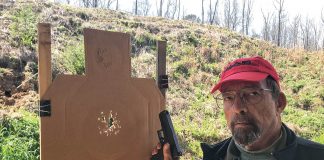
Practice target: Gun is S&W Model 64 .38 Special with Craig Spegel “Boot Grips” designed for concealment.
Match day. With Stage 2 of revolver event complete, score is 180-16X out of 180-18X possible, so far. Model 64 is in Ayoob Rear Guard holster by Mitch Rosen, on right hip.
Gail is happy that she has practiced with that old “20th Century gun,” S&W Model 67 tuned by Bill Pfeil with Hogue grips and riding in Milt Sparks #1AT holster.
Practice pays off. Match director Mark Rominger, left, hands Mas a gift certificate for a new S&W pistol, prize for top overall shooter. Score was delivered with Beretta 92 9mm pistol that’s concealed under Mas’ EOTAC lightweight vest.
This week I’m at the High Liability Instructors Conference hosted by the Florida Public Safety Institute. As the very theme underscores, the emergency services in America – fire, police, and ambulance – deal in the coin of human life. When lives are on the line, the civil liability is high. So is the risk. The firefighter who runs into a burning building to save a child, the cop who races toward the sound of the guns to stop a mass murderer, and the paramedic who resuscitates a bleeding AIDS patient with open sores are all risking their own lives to save someone else’s. Hopefully, they succeed. Sometimes, inevitably, they don’t. If someone is hurt or killed, in this litigious society, lawsuits get filed, even if the harm or the death was not the fault of the official responder. It’s a classic case of “damned if you do, damned if you don’t.”
Throughout the massive, beautiful campus of FPSI, you can hear the screech of tires and the crash of gunfire. It sounds as if an action movie is being filmed. And, truth to tell, some of this is fun. Chasing “bad guys” and ramming them off the training track with a PIT maneuver in a patrol car especially reinforced to take the repeated impacts, or going through a curve in the Skid Car – a vehicle fitted with a $45,000 apparatus that allows the instructor to cause it to lose traction and skid, and see if the driver can bring it back under control – is fun. Disney World could sell this experience for a hundred times the price of an E-ticket ride. But these instructors are here on business, all 265 or so of them, and the Institute is charging them only a hundred bucks apiece for 40 hours. But the knowledge they’ll bring back to their emergency service agencies is priceless. It will save untold lives in the future.
We are surrounded by reminders of the danger these people and their in-service students face every day at work. The wreath solemnly laid in the opening ceremony, to commemorate those who died in the line of duty. The Troopers’ Memorial which we pass each day on the way to classes.
We’re getting state of the art material from top instructors from around the country. But it’s also a recharging of the batteries, a renewed commitment to the jobs we all do. And it’s always a joy to be surrounded by people who accept high risk and high liability alike, in return for the high satisfaction of saving human lives and providing a sense of safety and peace of mind to others.
Florida Highway Patrol cars set up for the repeated collisions of PIT Maneuver training.
The Troopers’ Memorial reflects the many generations and both genders of FHP who have sacrificed their lives in the name of public safety. Note the older style uniform on right, with service revolver in crossdraw holster.
The helicopter on the tower, located on a live-fire range, allows rappelling and assorted other SWAT rescue maneuvers.
On the civil rights front as seen by gun owners, collectors of weapons, and assorted other practical folks, it always seems to be a matter of “win a few, lose a few.” The past few days seem to indicate a “lose a few” sequence.
The Draconian ammunition law in California which we discussed here a few weeks back has, despite a blizzard of mail from honest people all over the country to the Governor’s Office in Sacramento, has been signed into law. Read The Governator’s justification for it HERE.
Elsewhere in the nation, a little six-year-old boy took a camping tool to school with him to eat his lunch. The innocuous device included a fork, a spoon, and – gasp! – a tiny knife blade. Deemed to have violated the Zero Tolerance policy of no “weapons” on school grounds, the tyke was banished to some sort of local “reform school,” though common sense may finally be prevailing. Read about it HERE.
And, finally, a seventeen-year-old Eagle Scout with dreams of West Point was practical enough to have some emergency gear in his car including water, an MRE, blankets, and a two-inch blade folding pocketknife given him by his grandfather, a police chief. All were locked in the vehicle and inaccessible to him while he was in school. He has been suspended for a record period of time over this, with a blot on his record that may profoundly impact his hopes for West Point. Details are HERE.
For God’s sake…
Back in the blissful 1950s, I and most other elementary school boys I knew carried scout knives or pen-knives to school in our pockets daily. I don’t recall any knife fights by the swings or the sandboxes at recess. I remember bringing an unloaded Smith & Wesson K-22 revolver to junior high school as a science class “show and tell” thing, with both the teacher’s and the principle’s permission, in the early 1960s. In high school, many of us boys had rifles and shotguns locked in our cars during hunting season, with ammunition of course, so we could get in a couple of hours of hunting after school. There were no shootings in the parking lots. And that wasn’t in Mayberry, RFD; it was in the state’s capitol city.
Readers of this particular blog at the Backwoods Home magazine site seem to break down largely into two categories: seriously interested “gun people,” and the now-and-future rural dwellers who understand that firearms and related gear are simply logical tools for self-sufficient living. “Related gear” is the operative term at the moment, for this particular blog entry.
Even if you choose not to own firearms, you can’t live away from the city streetlights without artificial illumination at your disposal. The more you need that artificial illumination, the better you need it to be.
What we used to call flashlights and battery lanterns are now, in the crossover languages of modernspeak and tacticalspeak, “illumination tools.” We have the finest of their kind that have ever existed, branded with names like SureFire and InSight and Streamlight. Truth to tell, these devices have rapidly outpaced firearms in their rate of development in the last couple of decades. We now have lights more powerful than our grandparents could have gotten from the garage with advance warning of emergency, which are small enough for us to have in our pockets 24/7. Personally, I have similar technology on detachable white light and sometimes white light plus laser sight units that lock onto my guns.
They generally work on Size 123 batteries.
There are batteries, and there are batteries. And with this sort of hardware, you want the best. The photo below shows you what can happen when you “buy cheap” with this sort of stuff. It is said by reliable sources to have happened to a police officer in Texas who, like many cops today, had the light unit attached to his service pistol in a holster designed to accommodate same. The officer sustained burn injuries, and the famously rugged Glock pistol he was carrying was seriously damaged. His holster and patrol jacket were ruined, as well. The light unit in question is a heavy duty InSight M6X, one that I have a lot of personal experience with, and trust and recommend.
The problem has been, apparently, traced to cheap, substandard batteries. In addition it is not recommended that you mix different brands of batteries or mix batteries that have different charges, for example putting a new battery in with an old one.
The photo of the damaged gun and illumination unit come from an old friend who is a heavy hitter in the law enforcement tactical equipment world, and a watch commander on a good-sized Midwestern municipal police department. He strongly recommends using only the Size 123 batteries designed especially for tactical flashlights and tactical light units. I totally concur. My colleague states that he trusts only SureFire, Streamlight, Duracell, Eveready, and Sanyo brand batteries, and notes that SureFire and Streamlight are the only two brands of 123 batteries that he has determined to be optimized for performance in heavy duty tactical lighting units.
Whether for the SureFire, InSight, and Streamlight tactical lights I keep on some of my guns and available to quickly attach to some of the others, or for the SureFire A2 LED Aviator light that I carry virtually every day from when I put my pants on in the morning to when I take them off at night, I use SureFire Size 123 batteries. I order them in quantity and keep them well-stocked at home, and take a few on the road on extended trips. The rare times I’m caught without my own spares, I make a point of buying the available-everywhere Duracell brand for replacements. A call to InSight elicited the information that they currently ship their products with Duracells.
It ain’t just a performance thing. It’s obviously a safety thing, as well. Be warned. In the photo below, the substandard batteries didn’t just burn, they EXPLODED.
Have questions regarding this Blog? Please email us. Comments may appear online in "Feedback" or in the "Letters" section of Backwoods Home Magazine. We read every email you send us, but due to the sheer volume of mail we receive, we can't respond to each one.