
Archive for May, 2008
Massad Ayoob
Saturday, May 31st, 2008
Next week, my state’s fraternal association for police officers holds its annual conference, which will include a pistol match. It’s the de facto state championship for cops. It’s hosted by a different law enforcement agency each year, so the match is always different. Some years, the rules demand using the department-issue sidearm. Some years, the rules state that you can use any gun you are authorized to carry on duty.
For some, those are one and the same, but for those of us in more enlightened departments, it gives us some latitude. My agency’s standard issue sidearm for the last couple of years has been the Ruger P345 – the high-quality, low-priced .45 caliber semiautomatic that I recommended elsewhere on this blog to a reader who was looking for an affordable .45. Before that, since 1993, we had the same gun’s predecessor, the Ruger P90. I still have my “old” issue gun, so I can use either one if the rules turn out to be “standard issue only.”
My department is more liberal than some. We can carry a high quality double action .45 auto of another brand if it’s on the department-approved list. I have a SIG .45 that occasionally rides with me in uniform. Assorted high quality 9mm and .40 S&W caliber auto pistols are authorized for plainclothes and off-duty carry. For me, these include a Beretta 9mm that I’ve shot in at least three competitions in the past twelve months (won two, placed second in the other) and a .40 caliber Glock Model 22 with eight-pound New York trigger module with which I won the event I’m now preparing for in 2001, 2002, and 2003. Our department even allows cocked and locked 1911-style .45 automatics, if we can qualify at Master level with them. I wear one in uniform occasionally, and came in second at the “state shoot” with it in 2004.
I don’t know yet what the rules or the course of fire will be (they like to surprise us) but I’m told it will be a tough “qualification” course instead of the run-and-gun assault courses that have constituted the match for the past four years. Good news for me, since I “gun” better than I “run.” Since we probably won’t know the exact course of fire ‘til the morning of the match, I figured I’d take a few guns to the range and run them on “Course Seven,” the most challenging qualifier our state has on its books. Stuff like draw, fire three shots strong hand only, change hands, fire three more weak hand only, all in seven seconds. This would be easy with “qualification scoring,” in which the big oval “8-ring” of the police B27 target is counted as 5 out of 5 possible points, and a hit anywhere on the silhouette, even if it would have only pierced the bad guy’s earlobe or shot off his cuff link, counts for 3 out of 5 points. Unfortunately, at the match we use competition scoring, where the mark is a “10-X ring” that’s smaller than a business card, and some of the shooting is from 25 yards away. I can’t remember the last time I ever shot this course in “qualification scoring” with less than 180 out of 180 possible…and I have never shot a perfect 360 out of 360 possible on it in “competition scoring,” nor have I seen anyone else do so.
I ran the course with the Glock. Shot a 354 out of 360. That’s been good enough to win before. Shot it with my sleek 9mm Beretta: 352. The SIG P220ST? I used that gun for my personal best on this course, a 358, but can’t repeat that on demand, and today I got a 354. I tried the new and hotrock-popular Smith & Wesson Military & Police 9mm; I’ve been shooting the M&Ps since they came out, and they “like me,” but I got the same 354 score. Tried the old P90, that I’d won the state shoot with in 2000, but its blocky grip never fit my hand quite right, and I’d been away from it too long; I shot a 344.
Then I tried the currently issued “company gun.” The Ruger P345 gave me – you guessed it – a 354.
Aw, the hell with it…I’ll probably just shoot the match with the issue P345. That way, I’m covered even if the rules go strict and I have to use the gun the department gave me. But, you know, there were lessons in this morning’s experience.
The Ruger was the cheapest gun of the batch. Some of them had several hundred additional dollars of custom work in them, action slicking and such. The Ruger was literally out of the box. With some careful shopping you can buy a new one for $500 or less, and get an even better deal on a used one.
Lessons? 1.) A Chevy gets you just as far, just as fast as a Cadillac. 2.) Consistency is good, [though one could argue that consistency is also a key to mediocrity L]. 3.) As I constantly tell my students, it’s not so much about the gun so much as it’s about the shooter, and it’s not even about the shooter so much as it’s about consistent application of proven technique. It was the same guy and the same gun firing the 9-point hits on the 36-round course, as firing the 10s, whether the guns were plain or fancy. The imperfect hits came from the operator’s loss of concentration, not poor selection of tools.
I’ll let you know how it comes out. But in the meantime, tell the rest of us about your experiences in this vein.
The day you discovered that you hit just as many birds with an inexpensive Mossberg shotgun as with a Perazzi that costs more than some people’s homes. The day you realized the vegetables you raised economically in your garden tasted better than the finest high-dollar produce at the Food Boutique.
Validation of values, and lessons of life experience, sometimes come from unexpected quarters.

Left row, all .45s, from top: Ruger P345, Ruger P90, SIG P220ST. Left row, from top, Glock 22 in .40, 9mm Beretta 92, 9mm S&W M&P.

“Qualification scoring” is forgiving with the NRA B27 police silhouette target. Anything inside the competition 8-ring is 5 out of 5 points, “center mass”; 7-ring is 4 out of 5, and anything touching the black is worth 60%. In competition scoring, however, anything outside the 7/4 ring is scored as a miss…even a head shot, since the shooter has missed point of aim by a foot or so.

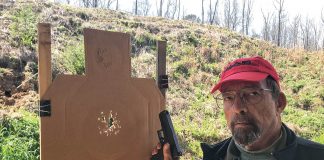
Competition-mode scoring demands more accuracy. Center oval is 10-X tie-breaker, next ring out is worth 10 points, then 9, etc. Anything outside the 7-ring is worth zero, and any late shot gets a minus-10 points penalty. Pistol is author’s department issue .45.
Posted in Uncategorized | 5 Comments »
Massad Ayoob
Thursday, May 22nd, 2008
A reader who describes himself as a retired law enforcement officer writes:
“I did not vote for Clinton in either election, however, I do wish to correct a common mistake made by Mas Ayoob and the firearms proponents. While Clinton did enact the Brady Bill, limiting the magazine capacity and changing the form (the way they could look) of firearms, the ‘Assault Weapons Ban’ that Mas speaks of was enacted by George the First. Bush One banned more firearms with the stroke of a pen than Clinton did in eight years. I don’t know why firearms writers and proponents continue to credit this action to Clinton, he might have wished for it, but he did not father it. The Brady Law sunsetted a number of years ago and has not significantly changed the way Law Abiding citizens own or purchase firearms. I can still own my MAC10, buy ammo for it and get the magazines I need to keep it running. Bush One and Two have hurt my firearm experience more than Clinton ever did. At least under him, I could still buy cases of .45 ACP for under a hundred bucks. With the other two, I can no longer buy new DaeWoo rifles and other foreign made firearms or get ammo at prices that are affordable to shoot. Thanks for your time.”
Wow. I think some respectful corrections may be in order.
Going chronologically, the crackdown on full auto weapons that limited licensed civilian purchase to those already in the stream of civilian commerce in 1986 was not enacted during any of the above-named Presidencies. It goes back to that year, when Ronald Reagan was President.
George Herbert Walker Bush can indeed bear blame for banning the importation of “assault weapons,” but certainly not of all foreign made firearms. Gun owners saw it as a betrayal, and voted against him in sufficient numbers to give him a margin of defeat that ushered in the Bill Clinton years.
The Brady Bill involved waiting periods and background checks for purchases. It had nothing to do with banning any kind of firearm.
The Assault Weapons Ban was indeed a Clinton thing, and very much a pet project of both Bill and Hillary Clinton. I am as grateful as our reader that it reached its sunset, under the administration of George Walker Bush, who could have pushed to extend it, but didn’t.
Any number of foreign made firearms are still available in this country, of course. The current increase in ammunition prices, as I’ve mentioned in the pages of Backwoods Home, is due only in part to military ammunition needs fueled by the War on Terror. It comes more from grotesquely skyrocketing prices of materials such as lead, brass, and particularly copper due to massive construction projects in other parts of the world, particularly China. It’s not something that the current administration, or any other, had power to control.
We may respectfully disagree, bro, but thanks for taking the time to write. Thanks for your service to the public. I’m glad you made it to retirement.
Posted in Uncategorized | 2 Comments »
Massad Ayoob
Wednesday, May 21st, 2008
Backwoods Home reader Ramie Pratt of Reno, NV writes, “I am considering buying a Hi-Point .45 ACP for home and personal defense. I haven’t heard of these before, however, the price seems to fit my budget. I was wondering if you or any of your writers had ever had any type of experience with the Hi-Point line of handguns.”
Solidly ensconced in the low price point end of the market, Hi-Point’s best firearm is their 9mm carbine, in my opinion. Their handguns are always worth a “flame war” when mentioned on Internet gun forums, with one side proclaiming them to be reliable and the other insisting that they’re jam-amatics that wear out prematurely.
Certainly, the massively heavy slide and strong spring the Hi-Point needs to function with the powerful .45 ACP (Automatic Colt Pistol) cartridge in a cheaply made blowback mechanism instead of using a more expensive-to-manufacture delayed unlocking system, require a great deal of force to operate the slide by hand in loading and unloading. This can make it a poor choice for the physically weaker members of the family who might be using it. Moreover, the factory itself strongly recommends that these pistols not be kept with a live cartridge in the chamber. This, coupled with the physical strength required to operate its slide, may make it a less than ideal choice for personal protection.
Suggested retail for the Hi-Point .45 is currently $186 (as per their website, www.hi-pointfirearms.com). For less than twice that, you should be able to buy a good, used Ruger .45 auto, either the aluminum frame P90 or the polymer frame P345. Both have earned wide acclaim for their outstanding accuracy and rugged reliability. Either is “drop-safe” with a live round in the chamber.
There’s certainly a place for a reliable sub-$200 handgun. Every type of sporting equipment and every type of tool has an “entry level.” That said, since guns are the most durable of durable goods and pass from generation to generation, it makes sense to spend a little more and invest in top quality.
Let’s hear from blog viewers as to their experiences with the Hi-Point handguns.
Posted in Uncategorized | 17 Comments »
Massad Ayoob
Tuesday, May 20th, 2008
Significant Other and I found our first bobcat on the property last night. It was in the carport, of all places, and darted off into the darkness when we caught it in the headlights. We’ve had foxes on the place before, but this was our first lynx.
Looking the critter up on the Internet, the SO said, “Bobcats are kinda like you.”
“Huh?”
“It says here, ‘The bobcat, Lynx rufus or Felis rufus, has a gray to brown coat.’ You’ve got both.”
“Uh, honey…”
“And it says, a Lynx rufus ‘black tufted ears.’ You’ve got those, too.”
“So,” I grumbled, “I’ll ask the barber to trim my geezer ear hairs, OK?”
“And,” she went on blithely, “it’s got a black tipped, stubby tail. Don’t me that’s not like you.”
“Well, I’m not gonna ask the barber to shave my butt!”
Since there ain’t no livestock or edible pets here, I’ve got no problem with the bobcat. I think it’s kinda cool to have him here. And if he goes off his own way, I suppose we’ll just have to consider him the missing lynx.
I just wish my sweetie would get over her new habit of calling me Rufus.
Posted in Uncategorized | 4 Comments »
Massad Ayoob
Friday, May 16th, 2008
Many a Christian pilgrim doubtless sought the Holy Grail. The term has drifted to collectors, and certainly, to gun collectors. Each seems to have one particular piece that has eluded him, for which he searches as assiduously as the fictional Indiana Jones went after the Ark of the Covenant. Shooter folk call them “grail guns.”
My grail gun is the Smith & Wesson Model 27 .357 Magnum revolver with a 3 ½ inch barrel. This was the shortest barrel length in which that iconic revolver was ever offered, and the length of the first one that came off the production line in Springfield, Massachusetts in 1935. That particular revolver was presented to J. Edgar Hoover, and reportedly was the centerpiece of his personal gun collection.
This was the revolver that introduced the popular .357 Magnum cartridge, and S&W offered it in barrel lengths up to 8 ¾”. That maximum extension was later reduced to 8 3/8”, when Smith & Wesson discovered that the latter was the length that made the cut for maximum sight radius in competition with the then-active United States Revolver Association (USRA). Since it was the only one of its kind, it was known simply as the “Smith & Wesson .357 Magnum.” In the mid-1950s, S&W introduced two more revolvers in that caliber, the smaller frame .357 Combat Magnum and the gray finish, plain Jane utility model of the big gun, which they called the Highway Patrolman. In 1957, the company went to numeric model designations, and the Combat Magnum became the Model 19, the Highway Patrolman the Model 28, and the original, the Model 27.
When I was a little kid, the only guns at home were rifles and shotguns; dad kept the handguns at his jewelry store until his youngest, me, got a little bigger. The only gun book in the house was a tattered 1947 edition of “The Shooter’s Bible,” also known as the Stoeger Catalog. In the Smith & Wesson section was a spotlighted photo of the 8 3/8” .357, and below it, an insert with the 3 ½” model titled “Super Undercover Service Gun.”
And, then and there, I imprinted.
I wanted one. Hell, I wanted both. When I turned 15, my dad gave me an 8 3/8” Model 27, and I used it for years in the centerfire stage of bullseye pistol competition, firing .38 Special target wadcutter ammunition. Nine years later, a young patrolman who had made the department pistol team, I had gunsmith Nolan Santy put a 6” barrel on it, since that was the maximum length allowed in “police combat” matches. I was 25 when I won my first state championship with it. That gun sits today in a safe deposit box, a “safe queen” as gun collectors put it.
I went on with life and with other guns, and my desire for a short-barrel Model 27 sublimated itself, sort of like an anaerobic bacteria that was just waiting for a chance to surface. It surfaced a few years ago, when I hit that age where we baby-boomers decide that with little time left, we just gotta have those things we wanted and couldn’t get when we were kids. For me, it was that 3 ½” Model 27.
Try to find one when you’re ready to buy one…
I’ve run across them with prices that I wouldn’t have paid for the former Governor of New York’s mistress. I’ve run across rusted ones, poorly refinished ones, and specimens that were customized until they didn’t look like the original, and all those things were deal-breakers.
I’ve gone through two Model 27 4” barrels in the last few years. Should be close enough, right? Nah…that ain’t the “grail” mentality. S&W is producing a limited run of “retro” .357s with 3 ½” barrels, but they’re 8-shot .357s instead of the traditional 6-shot, and the cylinders look different. Great guns…just not the exact same guns.
The 4” version of this revolver was good enough for the famed Col. Charles Askins, Jr., a man I was fortunate enough to know personally and learn a lot from. It was good enough for FBI agent Walter Walsh to use, along with a Colt .45 automatic, to win one of the Bureau’s most famous gunfights in the 1930s. I got to meet him late in life, and admire Walsh’s accomplishments enormously. And the 4” guns have the same superb S&W Bright Blue™ finish, the same checkering along the sight plane that marks it as the high-end Cadillac of the entire 1852-2008 epoch of a great American gun manufacturer.
But the half-inch difference in barrel makes a stark difference in looks. At 3 ½”, the 27’s barrel is almost level with its classically styled ejector rod shroud, and that plus the ramped front sight rising above it like a shark’s dorsal fin gives it a look like no other handgun. This was the barrel length of the Hoover gun, after all. It was the barrel George Patton chose for the ivory-handled S&W .357 he called his “killing gun,” now on display at the Patton Museum in Kentucky after a long stint on display at West Point. It was the length famed Oklahoma gunfighter Jelly Bryce chose when he swapped his Smith & Wesson .44 Special for the .357.
And, dammit, it was the one in the picture in that 1947 Shooter’s Bible that a little boy in New Hampshire once stared at so long, in such fascination.
If your first car was a ’57 Chevy BelAir and you head to the antique auto dealer to reclaim your lost youth, another variation of ’57 Chevy just won’t do. It has the same body, the same engine, the same transmission, perhaps…it certainly has the same dashboard, and drives exactly the same, and is thus identical from an operator’s perspective. But the chrome is different, that little rectangle on the rear fenders instead of the broom-shape sweep that begins by the headlights and reaches its widest point near those little tail-fins, which is the look that makes the ’57 Chevy of your memories.
That’s how the grail thing works. When my significant other watches me grind my teeth as yet another promised 3 ½” barrel Model 27 turns out to have a 4” barrel instead, she rolls her eyes and sighs, “Men.” But it’s of such things that grails are made.
So, if you run across a 3 ½” S&W heavy frame .357, let me know.
And if you’re looking for a grail for your gun collection – or for any kind of hobby collection at all – post it here and share it with us.
Posted in Uncategorized | 12 Comments »
Massad Ayoob
Monday, May 5th, 2008
The National Rifle Association’s “Eddie Eagle” gun safety program for children has just turned twenty years of age. Geared for younger kids, it features an instructor in an eagle costume who teaches the little ones a mantra for safety when they encounter potentially dangerous objects, such as an unsecured firearm that might be loaded.
STOP!
DON’T TOUCH!
LEAVE THE AREA!
TELL AN ADULT!
This widespread program is one reason why accidental death of children by firearms has decreased dramatically in this nation since just the 1980s, even though there are millions more guns in America now than there were then. In addition to the popular Eddie Eagle, NRA has worked with fish and wildlife departments at the state level to make gun safety classes widely available at little or no cost to the public, and hunter safety classes mandatory before a hunting license is issued.
It is said that the Eddie Eagle “four-step” program came from a young firefighter in Idaho who was an NRA member. There had been a spate of tragic accidents around the country involving children who had found unattended blasting caps. Our nation’s fire service had great success in mitigating future tragedies of that nature with a program that told kids,
STOP!
DON’T TOUCH!
LEAVE THE AREA!
TELL AN ADULT!
The young firefighter suggested to NRA that it would be wise to adopt the same concept within the context of firearms safety for young people. Wherever it came from, it obviously worked.
It’s tough to argue with success. It’s sad, though, that some schools have refused to allow the Eddie Eagle program, because it is sponsored by the NRA, and in some circles the NRA is seen as politically incorrect.
Whether or not it’s taught in the schools where you live, Eddie Eagle’s four steps to keeping kids from getting hurt by powerful, adults-only objects left unsecured is something that should be taught to all our little ones. Don’t wait for Eddie Eagle: teach it to them yourselves.
An easy way to remember it, guys, is to realize that it’s the same four things your lady is likely to say to you when she sees you ogling a particularly attractive member of the fair sex.
STOP!
DON’T TOUCH!
LEAVE THE AREA!
TELL AN ADULT!
Posted in Uncategorized | 1 Comment »
Have questions regarding this Blog? Just email us and we'll try to help. Comments may appear online in "Feedback" or in the "Letters" section of Backwoods Home Magazine. We read every email you send us, but due to the sheer volume of mail we receive, we can't always respond to each one.

|
|
|
|